
Liquid Immersion Cooling
What is liquid
immersion cooling?
A complete guide to one of the most innovative cooling technologies in cloud computing. Learn how it works, why it matters, and how it’s transforming the future of data centres.
The basics
What is liquid immersion cooling?
Let’s start with the fundamentals.The simple explanation
Liquid immersion cooling works by submerging computer servers directly into a special dielectric fluid — think of it as a heat-resistant bath designed specifically for electronics. The fluid isn't water, and it's not conductive, so it's completely safe around electronics. Instead of air blowing around your servers (traditional air cooling), the dielectric fluid surrounds all the server components and absorbs the heat much more efficiently.
Why dielectric fluid?
Dielectric fluids are non-conductive, meaning they don't conduct electricity. This is crucial — it means servers can be fully submerged without risk of short circuits or electrical damage. The fluids are also thermally superior to air, absorbing and transferring heat around 1,200 times more efficiently. This allows servers to run hotter, faster, and more reliably without the need for massive cooling systems.
How it works
The mechanics of liquid cooling
Understanding the flow and heat transfer process.The cooling cycle
Here's what happens: servers sit in a tank filled with dielectric fluid. As the CPUs, GPUs, and other components work hard, they generate heat. The fluid directly contacts all these hot parts — the chips, capacitors, power supplies, memory — and absorbs their heat. Once the fluid becomes warm, it's pumped out of the tank to a heat exchanger or radiator, where the heat is released into the environment. Then the cooled fluid circulates back into the tank, and the cycle repeats. It's a closed-loop system, so the fluid doesn't evaporate or get contaminated.
Why is this better than air?
Air cooling uses fans to blow air across hot components. The problem: air is a poor heat conductor, so data centre operators need massive fans, complex airflow management, and expensive air conditioning systems to keep temperatures down. With liquid immersion, the fluid is in direct contact with the heat source and absorbs it far more efficiently. This means you need fewer fans (if any), less air conditioning overhead, and smaller spaces to pack in more powerful hardware.
Key advantages
Why organisations are switching to liquid cooling
Real, measurable benefits that impact the bottom line and the planet.60% more efficient
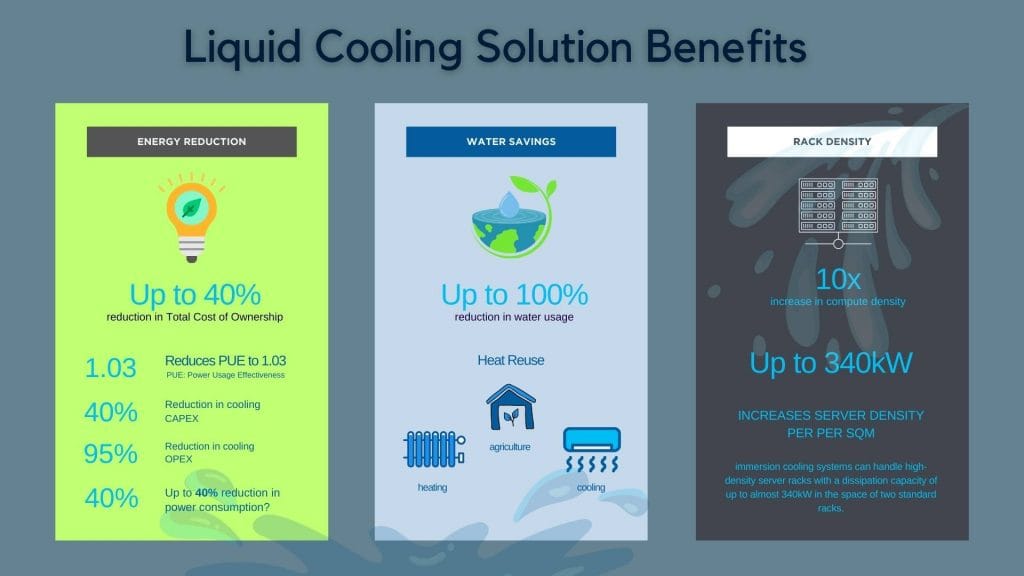
Liquid cooling reduces energy consumption compared to traditional air cooling. This means lower power bills and a significantly smaller carbon footprint.
Higher density
You can pack servers more tightly because you don't need massive air gaps for cooling. More computing power per rack means better ROI on data centre space.
Quiet operations
No need for loud fans means data centres are quieter and more pleasant to work in. Reduced noise pollution also means lower maintenance costs.
Longer hardware life
Because components stay cooler and more stable, they last longer. Less thermal stress means fewer failures and less frequent replacements.
Heat recycling
The waste heat can be captured and reused — heating nearby buildings or water systems. It's a circular economy approach to data centre operations.
Performance gains
Cooler components can run faster and more reliably. This translates to better performance for AI, machine learning, and high-performance computing workloads.
Liquid vs Air
How liquid immersion compares to traditional cooling
A side-by-side look at the differences.| Factor | Liquid immersion | Air cooling |
| Energy efficiency | 60% more efficient | Baseline |
| Server density per rack | Very high (100+ kW) | Limited (15-30 kW) |
| Noise levels | Very low (near silent) | Loud (fans running constantly) |
| Physical space required | Compact — smaller data centre | Extensive — more floor space needed |
| Heat recovery potential | Excellent (reusable waste heat) | Difficult (dispersed into air) |
| Water consumption | Minimal (closed-loop) | Significant (evaporative cooling) |
| Component lifespan | Extended (lower thermal stress) | Standard (higher fluctuations) |
| Maintenance complexity | Moderate (fluid monitoring) | High (fan replacement, filter changes) |
Real-world applications
Where is liquid immersion cooling used?
From AI training to financial services, liquid cooling is powering tomorrow’s computing.
AI and machine learning
GPUs and TPUs get extremely hot. Liquid immersion keeps them cool enough to train large language models and run complex AI workloads reliably.
Financial computing
Banks and trading firms run high-frequency trading algorithms that demand massive processing power. Liquid cooling delivers the performance and stability they need.
Rendering and media
Video rendering farms require sustained high performance. Liquid cooling keeps render servers running cool and fast for 24/7 operations.
High-performance computing
Scientific simulations, climate modelling, molecular dynamics — HPC workloads generate massive heat. Immersion cooling is the answer.
Cloud providers
Hyperscalers and other cloud providers are adopting liquid cooling to meet growing demand for computing power while reducing energy costs and environmental impact.
Edge computing
Smaller footprint, higher density, lower power — liquid immersion is perfect for edge data centres and on-premise infrastructure.
Common questions
Frequently asked questions
Absolutely. Dielectric fluids are specifically engineered to be non-conductive, which means they won’t cause electrical damage. Servers have been safely submerged for years in enterprise data centres.
The big picture
Why this matters for the future
Climate change and growing computing demands are pushing innovation forward.Climate impact: Data centres currently consume around 1-2% of global electricity. As AI and cloud computing scale, this will increase dramatically. Liquid immersion cooling reduces energy consumption by 60%, which means lower carbon emissions and a smaller environmental footprint for the digital infrastructure we all rely on.
The sustainability angle
Beyond just using less energy, liquid immersion cooling enables heat recovery — capturing waste heat and using it for building heating or other purposes. This circular economy approach transforms data centres from energy consumers into potential energy contributors. It's not just about staying cool; it's about doing it responsibly.
The performance angle
As AI workloads demand more computational power, traditional air cooling is hitting its limits. GPUs and accelerators push the boundaries of what's physically possible in air-cooled environments. Liquid immersion removes those physical constraints, allowing for denser compute, higher performance, and more powerful AI training — all while using less energy.
Ready to learn more
Interested in how liquid immersion cooling can benefit your organisation? Explore PeaSoup’s liquid-cooled cloud infrastructure and see how this technology powers sustainable, high-performance computing.