

Sustainable Cloud
Cloud computing requires significant energy, cooling and physical infrastructure. Sustainable cloud computing focuses on reducing that environmental impact through greater energy efficiency, innovative cooling technologies, efficient use of hardware and more responsible data-centre design.
Explore the technologies, measurements and approaches shaping more sustainable cloud infrastructure.
Essential Reading
Explore the technologies and principles behind sustainable cloud computing, from liquid immersion cooling and data-centre efficiency to the metrics used to measure energy and water consumption.What Is Liquid Immersion Cooling?
Understand how liquid immersion cooling works, why servers can operate while submerged in dielectric fluid, and how the technology can reduce the energy required for data-centre cooling.
Read Guide →
Single-Phase vs Two-Phase Immersion Cooling
Compare single-phase and two-phase liquid immersion cooling, including how each technology removes heat and the practical differences between the two approaches.
Read Guide →
Sustainable Cloud Infrastructure
Explore how cloud infrastructure can be designed to use energy, cooling and physical resources more efficiently while supporting modern computing workloads.
Read Guide →
Data-Centre Energy Efficiency
Understand where data centres consume energy and how infrastructure design, cooling, utilisation and workload efficiency can reduce overall consumption.
Read Guide →
Energy and Water Use in Data Centres
Understand why data centres consume significant amounts of energy and water, and how infrastructure and cooling choices can help reduce demand on these resources.
Read Guide →
Green Cloud Computing
Discover what green cloud computing means and how infrastructure efficiency, renewable energy, hardware utilisation and cooling technologies can reduce environmental impact.
Read Guide →
How Sustainable Cloud Infrastructure Works
Sustainable cloud infrastructure is not defined by a single technology. Efficiency comes from combining computing, cooling, data-centre design and resource management to reduce the infrastructure required to deliver digital services.
Efficient Computing
Learn how virtualisation and higher infrastructure utilisation can reduce the amount of physical hardware required to support computing workloads.
Efficient Cooling
Explore how modern cooling technologies can reduce the energy and resources traditionally required to remove heat from data-centre infrastructure.
Liquid Immersion Cooling
Discover how immersing IT equipment directly in dielectric fluid provides an alternative to traditional air-based server cooling.
High-Density Computing
Understand how efficient thermal management can support greater computing density, including demanding HPC and AI workloads.
Understanding Data-Centre Efficiency
Power Usage Effectiveness (PUE)
Understand what PUE measures, how it is calculated and what the metric can—and cannot—tell us about data-centre efficiency.
Water Usage Effectiveness (WUE)
Learn how WUE measures the water consumed by data-centre operations and why water efficiency is becoming increasingly important.
Cooling Efficiency
Explore why cooling represents an important component of data-centre resource consumption and how different cooling architectures affect efficiency.
Server Utilisation
Understand why improving utilisation can allow organisations to deliver more computing capacity from the same physical infrastructure.
Sustainable Cloud by Business Need
Reduce Energy Consumption
Explore how efficient infrastructure and cooling technologies can reduce the energy required to operate cloud computing environments.
Reduce Water Consumption
Understand the relationship between data-centre cooling and water use, and how alternative cooling technologies can reduce dependence on water-intensive systems.
Support ESG Objectives
Learn how cloud infrastructure decisions can contribute to broader organisational environmental and sustainability strategies.
Modernise Legacy Infrastructure
Explore how consolidation, virtualisation and efficient cloud infrastructure can reduce reliance on underutilised physical IT systems.
Liquid Immersion Cooling in Practice
From Air Cooling to Immersion
How the approaches differ.
Removing Server Fans
Why immersion changes the physical design and energy requirements of IT equipment.
Supporting High-Density Infrastructure
HPC/AI and high-density compute.
Heat Recovery and Reuse
What happens to the captured heat and the potential for reuse.
Industry Insights
Carbon reduction with edge computing
Carbon reduction with edge computing - Edge computing shifts data...
Read MoreWhy Edge Computing Matters for Climate Goals
Edge computing brings data processing closer to its source, reducing...
Read MoreDirect-to-Chip vs Immersion Cooling – Which is Best for AI
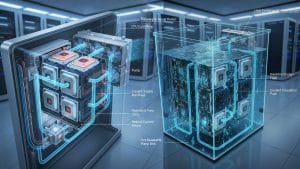
Providing a deep comparative analysis of Direct-to-Chip (DTC) vs. Immersion...
Read MoreHow Accurate is the Latest ChatGPT

How Accurate is the Latest ChatGPT? ChatGPT may not be...
Read MoreContinue Your Learning
Now that you understand the foundations of cloud computing, explore the next stage of your cloud journey.
Cloud Infrastructure
Explore the compute, storage, networking and virtualisation technologies that provide the foundation for modern cloud services.
Explore the Cloud Infrastructure Hub →Cloud Storage
Understand how object storage, S3-compatible technologies and modern storage architectures help organisations manage growing volumes of data.
Explore the Cloud Storage Hub →Sovereign Cloud
Explore how data location, jurisdiction, ownership and operational control influence cloud sovereignty and organisational data strategy.
Explore the Sovereign Cloud Hub →