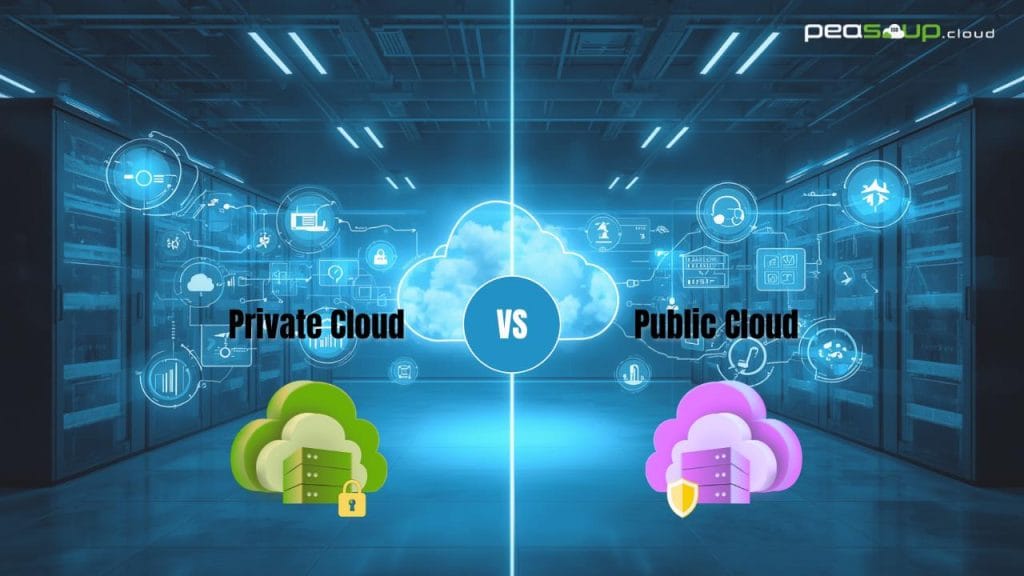
Private Cloud vs Public Cloud
Private Cloud vs Public Cloud: Which Is Right for Your Business? (2026 Guide)
Private cloud and public cloud are two of the most common cloud deployment models, but choosing between them is no longer as straightforward as it once was. While public cloud offers flexibility and scalability, private cloud provides greater control, customisation and security. Today, organisations must also consider hybrid cloud, multi-cloud and data sovereignty when deciding where to run their workloads.
Cloud computing has transformed how organisations purchase, deploy and manage IT infrastructure. Rather than investing heavily in on-premises hardware, businesses can consume computing resources as a service, scaling capacity as demand changes. However, not all cloud environments are built in the same way.
Understanding the differences between public and private cloud is one of the first steps towards selecting the right infrastructure for your organisation.
What is Public Cloud?
A public cloud is a cloud computing environment where infrastructure is owned and operated by a third-party provider and shared securely between multiple customers.
Major public cloud providers include Amazon Web Services (AWS), Microsoft Azure and Google Cloud Platform.
Customers consume resources on demand without purchasing or maintaining the underlying infrastructure.
Typical benefits include:
- Rapid deployment
- Virtually unlimited scalability
- Pay-as-you-go pricing
- Global availability
- Access to a wide range of cloud services
Public cloud is often an excellent choice for organisations requiring flexibility, short deployment times and the ability to scale quickly.
What is Private Cloud?
A private cloud provides cloud infrastructure dedicated to a single organisation.
Unlike public cloud, computing resources are not shared with other customers. The infrastructure may be hosted within an organisation’s own data centre or delivered by a managed cloud provider.
Private cloud combines many of the benefits of cloud computing—including self-service provisioning, scalability and virtualisation—with greater control over infrastructure, security policies and compliance requirements.
Organisations commonly choose private cloud for:
- Business-critical applications
- Sensitive data
- Regulated industries
- Predictable workloads
- Greater operational control
Private Cloud vs Public Cloud
| Public Cloud | Private Cloud |
|---|---|
| Shared infrastructure | Dedicated infrastructure |
| Highly scalable | Scalable within dedicated resources |
| Lower upfront investment | Greater control over infrastructure |
| Pay-as-you-go pricing | Predictable long-term costs |
| Managed by hyperscaler | Managed internally or by a specialist provider |
| Ideal for variable workloads | Ideal for sensitive or regulated workloads |
Neither model is inherently better. The right choice depends on your business objectives, security requirements and operational priorities.
Security and Compliance
One of the biggest considerations is security.
Public cloud providers invest billions in cybersecurity and physical infrastructure, making them extremely secure platforms.
However, security in the cloud remains a shared responsibility. Organisations are still responsible for configuring access controls, protecting data and managing identities correctly.
Private cloud provides additional flexibility by allowing organisations to define their own security policies, network architecture and operational controls.
For organisations operating in regulated sectors such as healthcare, financial services, legal or government, private cloud may simplify compliance and governance.
Cost Considerations
Public cloud is often perceived as the lower-cost option because there is little or no upfront investment.
However, long-term operating costs can increase significantly if workloads run continuously or data volumes grow rapidly.
Private cloud typically requires greater initial investment but can deliver more predictable costs over time, particularly for stable workloads.
When evaluating cloud costs, organisations should consider:
- Storage growth
- Data transfer charges
- Backup costs
- Disaster recovery
- Software licensing
- Operational management
The cheapest option initially is not always the most economical over several years.
Where Hybrid Cloud Fits
Many organisations no longer choose exclusively between public and private cloud.
Instead, they adopt a hybrid cloud strategy.
Hybrid cloud combines private infrastructure with public cloud services, allowing workloads to run where they are most appropriate.
For example:
- Sensitive business applications remain on private infrastructure.
- Customer-facing websites scale in public cloud.
- Backup copies are stored in secure cloud storage.
- Disaster recovery environments operate independently from production systems.
This approach allows organisations to balance performance, flexibility and resilience.
Where Multi-Cloud Fits
Multi-cloud takes the concept further by using services from multiple cloud providers.
Rather than relying on a single platform, organisations distribute workloads across different providers to reduce risk, improve resilience and avoid vendor lock-in.
Multi-cloud strategies are becoming increasingly common, particularly among larger organisations and managed service providers.
Why Data Sovereignty Is Becoming More Important
In recent years, cloud decisions have become about more than technology alone.
Organisations increasingly need to know:
- Where is my data stored?
- Which country’s laws apply?
- Who can legally access my information?
- Can I meet industry compliance requirements?
These questions have driven growing interest in sovereign cloud services, where data remains under a defined legal jurisdiction and governance framework.
For many UK organisations, cloud sovereignty is now an important factor alongside cost, performance and scalability.
Which Cloud Model Is Right for Your Business?
There is no universal answer.
Public cloud is often well suited to organisations prioritising rapid scalability, global reach and on-demand services.
Private cloud provides greater control, predictable performance and simplified governance for sensitive workloads.
Hybrid cloud offers a balance between the two, while multi-cloud strategies can increase resilience and reduce dependency on a single provider.
The best solution depends on your business objectives, regulatory requirements and long-term IT strategy.
Continue Learning
If you’re exploring modern cloud infrastructure, these guides may also help:
- What is Cloud Computing?
- NIST Definition of Cloud Computing
- What is Infrastructure as a Service (IaaS)?
- What is Multi-Cloud?
- What is UK Sovereign Cloud?
- What is S3 Storage?
Looking for a UK-based managed cloud provider?
PeaSoup Cloud provides UK-hosted Infrastructure as a Service (IaaS), S3-compatible object storage, Veeam Cloud Connect, cloud backup and disaster recovery services. If you’re evaluating public, private or hybrid cloud options, explore our solutions or speak with our team to discuss the best approach for your organisation.